calacala – Oruro

Recommendations
Altitude 3700 masl
[tabby title=”Description” open=”yes”]
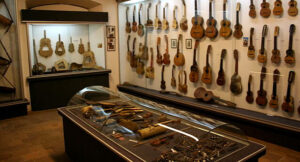
Simon I Museum. Patino – Oruro
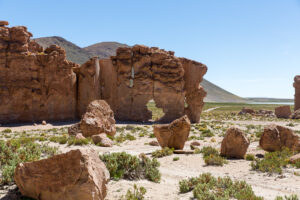
calacala, Aymara toponym that means “region of many rocks”, is the name of a mountain valley in the Bullaín canton of the Cercado province, a 21 km. southwest of the city of Oruro. The area where the rock art is found is also known as “Quellqatta” (“written”) and is located at a distance of 2 km. from the town of Calacala and approx.. 4.050 m.s.n.m. Prima facie, You can see an extensive and steep rock formation at the foot of which a small cave and an overhang are located..
The National Institute of Archeology (INAR), under the direction of Dr. Carlos Ponce S. fenced an area of 23 x 60 m to protect the main rock art site, whose great importance was recognized by Supreme Decree No. 09087 of the 5 February 1970 declaring the site a National Monument.
Calacala cave engravings and paintings
The rock art of the site is distributed in three sectors: A small cave and two sections of the rock wall forming a kind of shelter. The vast majority of the figures are painted in different shades of dark red., reddish, black and white. However, There are also a number of engraved motifs; in addition series of round artificial depressions (“domes”), that were carved into the rock in front of the rock art, They are lined up in rows and are an important part of the set, its function is unknown – likely, These are cavities to receive some liquid offerings..
One theme clearly predominates: camelids (most likely calls), mostly represented in groups, sometimes connected by a rope to their shepherds. There are also felines that, according to Aymara beliefs, were the “owners” mythical herds of llamas. Dominating the panel on the right is a large white flame. (60 cm high), the favorite animal for sacrifices in the Andean region.
Towards a cultural history of Calacala
Recent archaeological investigations show a long sequence of occupation in the Calacala basin. According to these data, the first establishment would have already occurred in the Archaic (ca.. 10.000 a.C.), following with a slight – but significant – occupation during training (1.500 a.C.). However, It is local development that presents the greatest evidence of intensive use of the basin. This continued during the Late Horizon (ca.. 1400 d.C.) until the Colonial Era.
This way, The importance of Calacala is proven within the pre-Hispanic regional context. This importance could be related to the strategic location of the basin., becoming part of a corridor that connected several ecological floors. This aspect promotes the need for further research, which will contribute to pre-Hispanic knowledge of the southern Andes.
The Calacala archaeological-ecological park project
In 1999, the Bolivian Rock Art Research Society (SIARB), supported by GTZ (German Development Cooperation), H. Oruro Mayor's Office, the National Anthropological Museum “Eduardo Lopez Rivas” and the community of Calacala, started this project, which in the long term has the following objectives:
1. ensure the preservation of Calacala rock art through adequate physical protection (fence repair), effective administration and raising awareness of locals and visitors about the value of this cultural and natural heritage,
2. carry out a systematic registration and documentation of rock engravings and paintings,
3. take advantage of this cultural and natural resource in a rational way for tourism, with infrastructure and signage that facilitate visits to the site and at the same time provide extensive explanations about its meaning,
4. carry out a diagnosis of the flora and fauna of the region,
5. expand the cultural and tourist offer with circuits to the surrounding areas (eco-tourism), a museum and information center about the role of camelids in Andean cultures,
6. support the sustainable development of the region with the implementation of workshops and sales of crafts, based on camelid products and inspired by the iconography of the rock art of the place.
In October of the year 2002 The SIARB and the Mayor's Office inaugurated the walkway in the archaeological park. This work was financed by the German and Dutch Embassies and the Bradshaw Foundation. It facilitates the visit of tourists who have a better view of the rock engravings and paintings. Besides, Help preserve these artistic and archaeological testimonies, since no visitor will climb the rock, action that damaged the site in the past. At the moment, The construction of a Tourist Service Center is being prepared.
Regulations for visits to the archaeological park
1. Each tourist registers and enters with a ticket.
2. Visiting the site is done through the gateway. Tourists are not allowed to enter the rest of the protected area.
3. It is prohibited to touch the wall with rock art, live, paint or damage rocks in any way.
4. Do not leave garbage in the place. use the trash can.
5. A sanctions regime is established for violators.
These minimum standards have the objective that all visitors can enjoy the Archaeological Park and help the preservation of this National Heritage.. Collaborate with park staff. Write your comments and suggestions in the visitor book.
Other tourist attractions in the region
The road from Oruro to Calacala passes through the town of Sepulturas with its colonial church (one of the most outstanding Baroque-Andean temples in Peru and Bolivia). The name Sepulturas comes from the Aymara funerary towers (chulpares), of which currently only one remains, next to the road, and unfortunately already half destroyed.
Before entering the town of Calacala you reach the Chijchi Khollu hill, which is popularly identified as a decapitated saurian, at the foot of which there is an opening known as “the friar's cave”; The locals say that a priest who had fallen in love with a young girl disappeared in that place.. This is a crack in the rock with a dark spot, where a spring of water comes out; near Calvary “Lord of the Lagoons”, which is another sacred site related to water, since it is surrounded by a large lagoon. He 14 September the festival of the Exaltation of the Holy Cross is celebrated in Calacala, festival best known for its popular name of the Tata Laguna festival.
[tabby title=”+Places”]
[do_widget id=arpw-widget-31]
[tabby title=”Info PDF”]
[gview file=”https://boliviaesturismo.com/wp-content/uploads/2015/10/El-carnaval-de-oruro.pdf” cache=”0″]
[tabby title=”Tourism Companies”]
[do_widget id=arpw-widget-6]
Do you want to advertise your tourist services free?
Tourist agency
Travel agency
radio taxi service
Hotels
Tour guides
Interdepartmental transportation – rural
others…
[tabby end]
[do_widget id=rednao_smart_forms_widget-4]