Amboro National Park
“Amboró National Park” is among the protected areas with the greatest biodiversity on the planet given its biological wealth. . are registered 2.659 higher plant species; Regarding the fauna, more than 1.200 species.
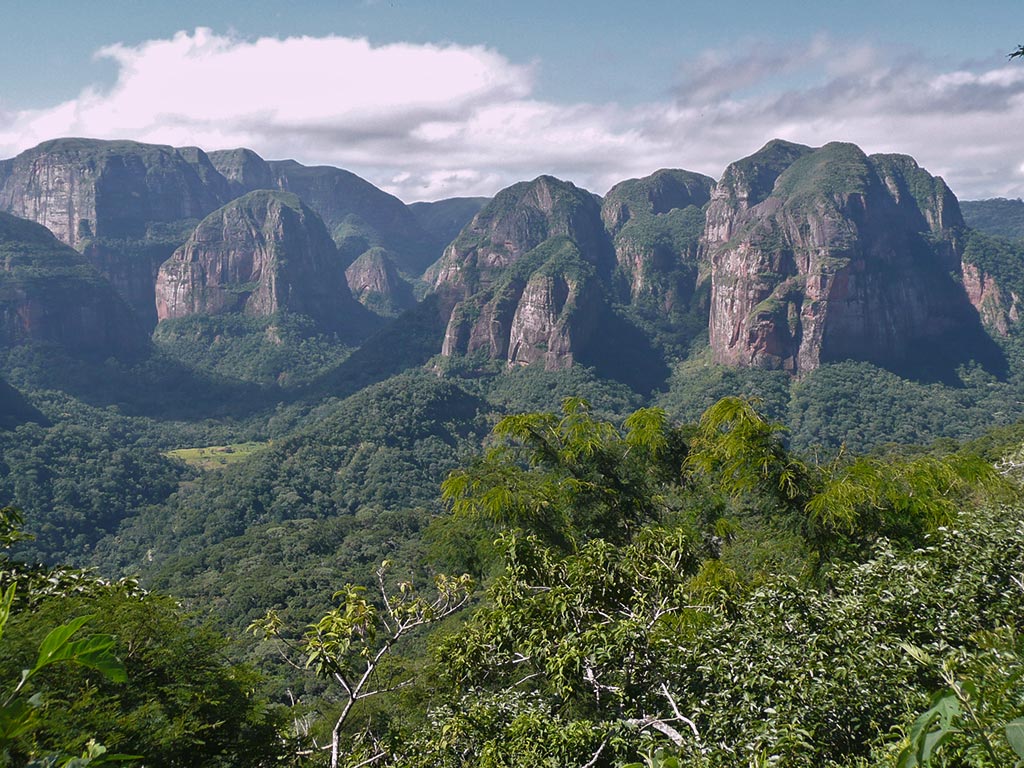
It is one of the parks with the greatest topographic variation and biodiversity in Bolivia, and headwaters of important regional rivers. It was initially created in 1973, then expanded into 1991.
Biodiversity
Amboró Park is home to thousands of animals and plants, some of them are unique in the world.
parts
109 species: They are within the Integrated Management Area. The majority is found in the different sub-basins and its richness decreases rapidly depending on the altitude..
They are threatened by mining activity in the Surutú and Yapacaní river basins..
Aves
843 species: It constitutes the 60% from the list of species that exist throughout the country. It is one of the most diverse conservation units on the planet.. Of the total, 209 species have some conservation status; 9 of them are considered threatened, vulnerable or declining; 7 species are in danger of extinction.
Mammals
127 species: The areas of greatest diversity and relative abundance are between the Ichilo and Macuñucú rivers.. Hay 7 primate species, 15 marsupials, 19 carnivores, 44 chiroptera, 7 edentulous, 1 perisodáctilos, 4 artiodáctilos, 1 lagomorfos, 29 rodents. Numerous species are considered key to the functioning of ecosystems.
Reptiles
105 species: It is the region with the greatest wealth of reptiles in the country and, probably, the most diverse in Latin America. in amphibians (76 species) also has, together with Ecuador and Peru, the greatest variety. It is one of the five “megadiversity” areas of Latin America. One species of amphibian and three species of reptiles pose some degree of threat.
Flora
26 vegetation units: It has more than 2.961 recorded higher plant species.
It is estimated that a number greater than 3.500 species in the area.
The Amboró is a refuge for threatened forest species such as the mara, the cedar, the mountain pine and the walnut.
The enormous variety of ecological floors of Amboró Park determines an exuberant diversity, but endemisms are also worth highlighting. The vegetation unit of the inter-Andean semi-arid Chaco forest provides numerous endemisms, especially in Cactaceae. Saxicolous and rock vegetation, that occupies rocky cliffs, is dominated by large bromeliads, with endemisms such as Cleistocactus samaipatus and C. aurespinus. The humid-hyperhumid rainforest of the Amazon provides notable endemisms.
In the PN-ANMI Amboró there are registered 2.659 higher plant species; However, it is estimated that there are more than 3.500 species. Among the species of flora found in the area we can mention: demon (Myrsine coriacea), el khellu kheluu (Bocona frutescens), the brush (Myrica pubescens), the bibosi (Ficus sp.), I loved the grape (Pourouma sp.), the pacay (Inga velutina), the guitar player (Didymopanax morototoni), the red nail (Palicourea bryophila), the mara (Swietenia macrophylla), the mountain pines (Podocarpus sp.), el quite (Juglans boliviana), the cannelloni (Aniba coto). The presence of extensive patches of giant tree ferns is of enormous relevance. (Cyathea sp., Alsiphila sp.) in the cloud forests. In addition, the pachiuva is found (Exorrhiza scrotum), the acai (Euterpe prayer) and several species of endemic orchids.
The enormous variety of ecological floors determines an exuberant diversity, but endemisms are also worth highlighting. The vegetation unit of the inter-Andean semi-arid Chaco forest provides numerous endemisms, especially in Cactaceae. Saxicolous and rock vegetation, that occupies rocky cliffs, is dominated by large bromeliads, with endemisms such as Cleistocactus samaipatus and C. aurespinus. The humid-hyperhumid rainforest of the Amazon provides notable endemisms, such as Bolivian Talauma.
Access
The area is surrounded to the south and north by two main roads, both joining the cities of Cochabamba and Santa Cruz. From these roads several secondary roads emerge that allow entry without much difficulty to the ANMI..
In the North Zone the main access is through Buena Vista, Santa Fe o Yapacani, along the new Cochabamba-Santa Cruz highway, and then you access the ANMI through several trails (Mirrors, Saguayo, La Chonta, Macuñucu) and the Yapacaní River in the rainy season. In the South Zone you enter through several towns along the old Cochabamba-Santa Cruz highway. (The Lathe, Samaipata, happening, Pampa Grande, Masaral coama Coampa).
Legend of Amboro
The origin of the name of the park comes from a legend of the Chané tribe, native to the eastern plains. Their cacique or chief called Grigotá was the one who preserved order in nature, source of life and prosperity. One day he had to undertake a long trip and left his two sons Amboró and Parabanó in charge of the area.. But they were careless and allowed the jungle to be invaded, destroyed and contaminated, affecting the order of nature. When Grigotá returned and saw what had happened, made the invaders disappear thanks to the forces of wind, rain, lightning and thunder, but he did not spare his children and turned them into great mountains so that they would be the eternal guardians of the place., next to each other.
Fuente: www.buenavistabolivia.com/