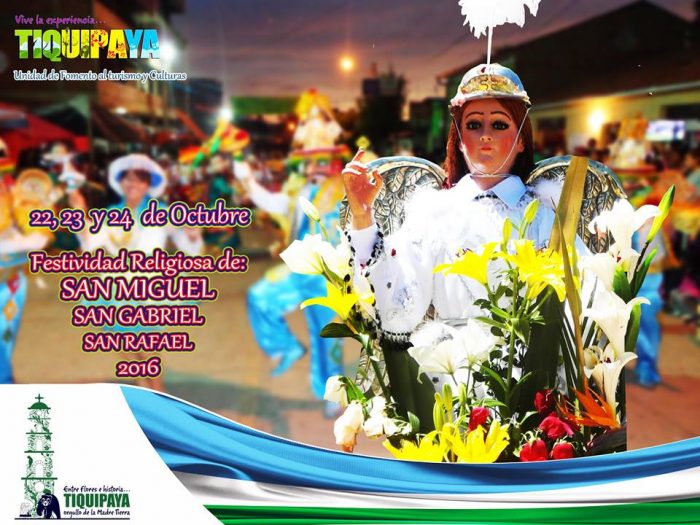
Religious Festival of Saint Michael – Saint Gabriel – Saint Raphael
“OFFICIAL LAUNCH”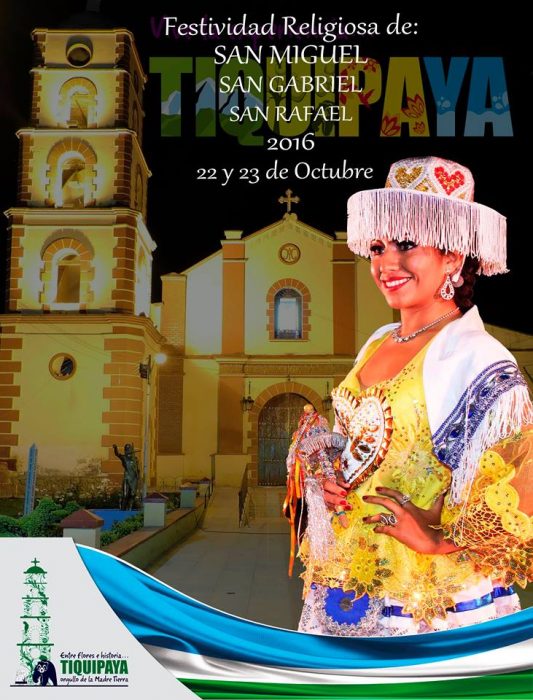
Religious Festival of Saint Michael – Saint Gabriel – Saint Raphael.
– MONDAY 17 from October to Hrs. 19:00 at the Door of the Temple of San Miguel in Tiquipaya.
– Participation and demonstration of FRATERNITIES (Diablada, Suffering, tuffs, Kullawada, Tinkus, Salay, etc.)
– BANDS – fireworks and much more.
Tiquipaya is located in the Quillacollo province of the Cochabamba department.. The capital city of the municipality (District IV) is centered approximately 11 km from the city of Cochabamba the way to visit this city is through Reducto Avenue found at km9 of Blanco Galindo Avenue to the north and Ecological Avenue continuing towards the west.
 Tiquipaya, Third Municipal Section of Quillacollo, It is located north west of the city of Cochabamba., among the 17 degrees, 20′ South latitude, 65 degrees, 74′ longitude of Oeste, with an approximate extension of 57,208 Ha. 2.640 m.s.n.m; with 22º C temperature and 600 m.m. of rainfall.
The Term Tiquipaya is of Aymara origin, the historian Don Rafael Peredo A. says in his “Monographic Essay of the Quillacollo Province”, 1960, Tiquipaya, comes from Aymara which means: “Flat confluence between two rivers”. in the region, numerous places maintain the original designation derived from this language; y, In the mountain range there are still communities that speak the Aymara language, as mother tongue. Qheshua domination over the Aymara culture, arrived in the time of the Inca Kapaj Yupanki, In this regard, the author indicates: “The Inca Kapaj Yupankiki, ended the civil war between the Kari and Sapalla” (Aymara chiefs), who disputed the control of extensive grazing and cultivation lands). Pointing out the definitive jurisdiction of the chiefs in discord. He ordered a ditch to be opened to avoid new disputes, separating the disputed fields”. “The conclusion of the fight culminated in boisterous celebrations, drawing a dividing line from the heights of Taquiña to the region of Caspichaca.… that boundary that served to pacify Karis and Sapallas, It is the limit of the Cercado de Cochabamba and the Quillacollo Province, passes through Linde in the jurisdiction of Tiquipaya”.
 Since the creation of the Quillacollo province in 1905, detached from Tapacarí, Tiquipaya was a canton of the First Quillacollo Section, until in 1957 (23 September), The Law was promulgated that decrees the creation of the Third Municipal Section of Quillacollo, established by capital Tiquipaya.
[tabby title=”Physiography” open=”yes”]
The municipality includes ecological floors with characteristic microclimates of, Valles, Puna, Yungas and Subtropics Areas whose potential is agricultural and livestock production. Abundant archaeological evidence found in areas near the Tunari mountain range. The historian José Macedonio Urquidi, in his famous work “Origins of the Noble Villa de Oropeza”, speaks of the existence of ceramic artifacts with ideographic or hieroglyphic ornamental motifs, proof of the existence of Aymara and Quechua cultures, Who were the colonizers of this territory?.
[tabby title=”Climate”]
The microclimate of the jurisdiction is variable due to the difference in heights. The average annual temperature is 14.5º C, with monthly averages that vary from 10.4º C in the months of June to July, at 16º C in November. The average annual rainfall is 620 mm/year, near the 90% of precipitation occurs in 6 months, from November to April.
The seasonal average relative humidity of AASANA is 57% with a variation of 50% in October and 68% in february. In addition, there are records of predominant winds from East to West with a wind speed of 1.1 m/s (91 km/day).
The dry season begins in May and ends in September.: being the driest months, mayo, June, July and August. Potential evapotranspiration represents a 81.2% marked by the rainy season that begins in the month of November and lasts until mid-March.
[tabby title=”Ecological floors”]
The territory of the Municipality covers three agro-ecological floors:
North, head of tropics: located at a height less than 2.700 m.a.s.l. whose soils are part of fertile thermal and quaternary terraces with a variety of tropical flora and fauna, They are lands suitable for agriculture and livestock, which are scarcely cultivated due to lack of communication routes with markets. It has a minimum temperature of 17ºc and a maximum of 30ºc, with intense rainfall that reaches 1.200 mm/year.
Central area, puna: between the levels 2.780 until 4.600 m.s.n.m. pluvial and diluvial soils, from north to south it presents an irregular relief, mountainous area made up of hills and successive basins with slopes that fluctuate between 30% y 60%, of dry forests and thorny steppes with sparse vegetation. With a climate that reaches temperatures below 5ºC in winter and up to 17ºC in summer, It has a rainfall that fluctuates between 400 y 600 mm/year. There are important water reserves in the area, Among the main ones are the Escalerani and Wara Wara lagoons that provide drinking water to the city of Cochabamba..
To on, Valleys area: That extend between the levels 2.250 y 2.750 m.a.s.l. whose soils are part of Quaternary and Tertiary basins near the mountain ranges, It has a flora and fauna typical of the valleys, a minimum temperature of 2ºc in winter and a maximum of 27ºc in summer, with average rainfall of 600 mm/year, The area is crisscrossed by several small rivers that flow into the Rocha River..
[tabby title=”Flora”]
The vegetation cover of Tiquipaya, Due to its climatic characteristics and its height, it is reflected in small low forests, in certain enclave sectors, with canopy 6-8 meters high, The coverage is variable and depends on its degree of conservation.. The ravine area is fundamentally characterized by kewiñas (Polypepis besseri), a characteristic species among some 2800 – 3500 m. altitude. The grassland area generally has less coverage, lower biomass and floristic diversity, There are areas with a lot of permanent moisture in the soil called wetlands or high Andean meadows made up of large compact cushioned juncaceous trees., of which are presented as pure populations of a single species, according to the localities.
The following flora composition can also be noted: • Flores: Rosas, gladiolos, carnations, freesias, marigoles, nardos, margaritas, always alive, delusions, chrysanthemums dahlias, etc. • Fruit trees: Peach, Damascus, albarillo, apple, pera, quince, walnuts, uva, tuna, fig, custard apple, stomach, peramota, and some citrus. • Forestry: Eucalyptus, Eucalyptus camadulensis, weeping willow, Cypress Pine, Carob tree, Kiswara, Pino Radiolo, Chillaos, Ula Ula, wild song, Chiliji (Ceibo), Aliso, Sehuenca, Jarka, Chirimolle, Poplar, Jacaranda, Tora, Quiñi, Chagatea. • Legumes: Cauliflower, cabbage, broccoli, spinach, radish, chili, tomato, parsley, onion, lettuce, pepper, cucumbers, beetroot, length, pea, fault, bean, with them, carrot and others.Alpha Alfa Foragers, white clover, red clover, Fescue pasture, foxtail grass, Falaris Pasture, RAI gross and others. • Wild: Hollowcane, Chillca, Alpha Alpha, Sunflower, weeping willow, iron, tara and others. Medicinal Peach (huajchabarbera), hero hero, borage, nothing, nothing, sarsaparilla, gladion (horsetail), pinku pinku, ockho ruru, I shout, dandelion, plantain (Anku anku), melissa, elder, chamomile, button, gold, hediondilla, back, noon, ordinary rose, passionflower (lock bought), muni, tarco , altamisa, pay attention, holy thistle and others.
[tabby title=”Fauna”]
To date, they have registered 30 mammal species, 163 bird species, two species of reptiles and two of amphibians. According to the National Protected Areas Service (SERNAP), Among the birds there are four endemic species: Oreotrochilus Adela, Aglaeactis pamela, Asthenes heterura y Poospiza garlepi, which almost exclusively inhabits groves of Polylepsis besseri subtusalbida and is in danger of extinction. The species Sicalis luteocephala also inhabit, Saltator rufiventris, Oreomanes fraseri, Diglossa carbonaria, who are vulnerable, and Leptastenura yanacensis which has a high priority for research and conservation. In the Taquiña basin area, the presence of guinea pigs is also observed (Microcavia niata), viscacha (Lagidium viscacia), fieldmouse (Rattus rattus), zorro (A guilty dog), bush cat (The color of the cat), rats of the genus Ctenomys, frogs of the genus Pleurodema. Other mammals such as the skunk (Conepatus chinga rex), the guinea pigs (Micorcavia niata, Cavia aperea y Galea musteloides), lizards of the genus Liolaemus, insects of the orders: Formicides, Hymenoptera, Odonata, Lepydoptera, Dyptera y Coleoptera. Bats of the genera: The Histicipation of the Life of the Buree.
[tabby title=”Turismo”]
The recommended sites for adventure tourism are the Escalerani Lagoons and the Mayu Lagoon.. And among others there is also a magical place, Los Molinos, special for lovers visiting.. Among the most important activities is the festival of San Miguel Arcangel. 24 October, and the trout fair 14 September and the flower fair the first week of September.
[tabby end]
Fuente: www.wikipedia.org