El Jichi – Holy Cross
[ap_dropcaps style=”ap-square”]“P[/ap_dropcaps]To explain what jichi is, it is advisable above all to take the path that leads to the times of ago ñaupas and enter into the account, for this partial case, of how the ancestors of the earthly race lived, ancient settlers of the plain. People of little needs and no greater scope, The region that served as their home was not very generous., nor did it easily provide them with all the goods necessary for their subsistence.
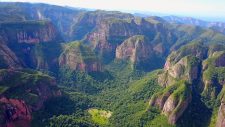
To talk about the main elements of life; water was not abundant in the region. In the dry season it was reduced and there were days when it was difficult to obtain it.. Thus in the fields of Grigotá, in the Chiquitos mountain range and in the vast surrounding plains of it.
Hence, those primitive aborigines paid delicate attention to preserving it., considering it as a gift of divine powers, and have assumed the existence of a supernatural being in charge of its guardianship. This being was the Jichi.
It is a myth shared by mojos, chanés and small than this genius of water countryman lived mostly in the natural deposits of the liquid element. To keep him satisfied and well loved, it was necessary to worship him and pay him certain offerings..
The Spaniards of the recent settlement on earth picked up the version and agreed to the myth., with little or no qualms. Even more so, their descendants, the Creoles, as consubstantiated with the motherland as the aborigines themselves, and especially if they have a few drops of their blood in their veins..
Like all mythical zoomorphic beings, The jichi does not belong to any of the known classes and species of terrestrial or aquatic animals. Half snake and half saurian, According to those who claim to be experts, has a thin, oblong and flat body, of a rubbery appearance and a hyaline color that makes it blend in with the waters in whose bosom it lives.. It has a long, narrow and flexible tail that aids agile movements and short, plump limbs ending in nails joined by membranes.
How it lives at the bottom of lagoons, puddles and mudholes, It is very rare that it is seen, and that very quickly and only since dusk falls.
There is no need to misuse water, nor spend them too much, because the jichi suffers and can disappear. You should not uproot aquatic plants that grow in your home., from tarope up, nor remove the pochi granules that cover its surface. When this has been done, despite traditional prohibitions, the liquid begins to diminish, and it doesn't stop until it's exhausted. This means that the jichi has left.”
Fuente: https://www.soysantacruz.com.bo