Department of Tarija
Recommendations
…
[tabby title=”Description” open=”yes”]
Department of Tarija
Historical Review
Tarija was founded on 4 July 1574 by Captain Luis de Fuentes y Vargas, due to an order from Viceroy Francisco de Toledo, his first name was “Villa de San Bernardo de Tarixa”, and its main objective was to defend the Spanish and Indian vassals of the King from the attacks of the Chiriguano Indians.
Shortly after founding, The first Town Council was formed with the most notable neighbors, headed by the aforementioned captain. The first inhabitants were the “Tomatas”, very similar to ours “Chapacos”, whiteid, altos, robust, horsemen and hospitable.
During the war of independence, he 15 April 1817 The battle of La Tablada took place, which is the most significant victory of the Tarijeño guerrillas against the Spanish forces, Therefore, that date is celebrated as a departmental anniversary..
Among the heroes of those epic days we can mention the native Méndez “The Motorcycle”, to Rojas, Aviles, Mendieta and the León brothers. Tarija is rich in Folklore and traditional customs, and there are radical differences in each of its provinces. The traditional generosity of its inhabitants offers national and foreign tourists, both in the city and in the countryside, the most cordial and affectionate welcome.
GEOGRAPHY
The department of Tarija is located in the south of the Republic of Bolivia; It limits to the north with the department of Chuquisaca, to the south with the Republic of Argentina to the east with the Republic of Paraguay and to the west with Chuquisaca and Potosí. It has an extension of 37,623 km.2 and a population of 291,407 inhabitants (census 1992). The capital of the department is the city of Tarija (1,866 m.s.n.m) located between 21° 32′ 00″ south latitude and 64° 47′ 00″ longitude west of the Greenwich meridian, has an extension of 37.623 km and its population is approximately 200.000 inhabitants, has 6 provinces and 157 cantons.
CLIMATE
The city of Tarija is located 1924 meters above sea level, Its climate is temperate and very pleasant, Its valleys have an average of 17 a 23 degrees and in tropical places it ranges between 25 y 35 degrees, The rainy season includes the months of December to February. Temperate and cold in the west.
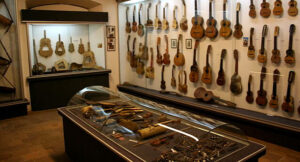
musical instruments
THE BOX
It is a double-headed, direct-hit tubular membranophone., relatively small (between 6 y 15 cms. tall and 39 a 40 cms. in diameter) and very light, because it must be carried and executed in one hand. Its frame is constructed of finely laminated wood and its patches of internal cow stomach membrane, which are fixed to the frame by first sewing them to two cane rings that border it and then using a string that joins both rings in a zigzag pattern.. The box is the only instrument that can be played by women, what is undoubtedly an Inca heritage.
THE VIOLIN
It is a bow-rubbed chordophone, that is built both in the communities and in the city of Tarija. Goyena describes it “…the background, sashes and handle are constructed in one piece, digging a piece of walnut wood, cedar the sauce. The top is usually made of pine, orange pegs and antler tailpiece…The bow has the rod and nut made of orange wood, the ropes are formed by horsetail manes…”. The melodies played with this instrument are pentatonic, with a thimble as a rhythmic base; its character is binary.
THE ERQUE
It is a clarinet formed by a pavilion made of hollowed-out bull horn., to which it is attached at its narrowest end, a mouthpiece (“straw”) of hollow cane 10 a 20 cms, longitudinally sealed almost halfway to obtain a thin sheet that acts as a vibrating tab. The melodies played with this instrument are generally tetratonic, binary rhythmic character.
THE CANE
It is a transverse natural trumpet of gigantic dimensions (until 5 meters long) which is constructed of perforated and reinforced hollow cane, to which a pavilion is attached at one end (“corincha”) made from cow tail, and on the other side is the embouchure, which is a lateral opening of the reed.. The melodies played with this instrument are tritonic, rhythmic behavior is binary.
THE GUITAR
It is not an instrument specific to the region, but it is widely used by different folk groups to accompany the different rhythms of Tarijeña music such as La Cueca and La Chacarera.. If you consider the calendar of instrumental music, the period of use of the chapacos instruments is observed: The erque from All Saints to Carnival (November-February), La Caña from the La Cruz festival, San Roque and Rosario (May-October), The Violin during the Easter festival, Christmas and new year, La Camacheña from San Juan to Todos Santos.
FUENTE: https://www.turismo.tarija.gob.bo
[tabby title=”+Places”]
[do_widget id=arpw-widget-50]
[tabby title=”Info PDF”]
…
[tabby title=”Tourism Companies”]
[do_widget id=arpw-widget-6]
Do you want to advertise your tourist services free?
Tourist agency
Travel agency
radio taxi service
Hotels
Tour guides
Interdepartmental transportation – rural
others…
[tabby end]
[do_widget id=rednao_smart_forms_widget-4]